





What Australian Players Should Check Before A Cashout
Most payout problems begin before the request is sent. Players finish a session, open the wallet, and only then notice that their profile is incomplete, a payment detail is outdated, or a confirmation step was never finished. Rocket Play is available in Australia for legal-age users, so the smartest habit in 2026 is to treat the banking area as part of setup, not as a last-minute task.
Imagine this situation: you expect the whole process to take a minute, but the account asks for extra confirmation because one detail does not match. Usually, that is not a serious issue - it is just a reminder that preparation matters. Check personal details, review recent transactions, and make sure your preferred payment route can also be used for receiving funds.
Account Readiness Comes First
A clean profile makes everything easier. Full name, date of birth, contact details, and address should be entered clearly and consistently. Even a small mismatch can lead to extra questions later.
Picture a player who registered quickly on a phone and shortened a surname just to move faster. Weeks later, that shortcut becomes the reason a request is reviewed more carefully. It is better to fix small details early than when money is already waiting to move.
Why Payment Matching Matters
As a rule, consistency helps. If someone deposits through one option and immediately tries to cash out through another, the account may need a closer look. Many players reduce friction by choosing one main method, sticking to it, and keeping simple records after each transaction.
How The Payout Journey Usually Works
The route from balance to bank account usually has several stages. First, the player checks that the amount is actually available. Then comes the request itself. After that, the platform reviews the account and the chosen method. Only then does the receiving side process the transfer.
If you are new to Rocket Play, think in phases, not in one instant result. Imagine sending a request late on a busy evening after changing your contact details the same day. Nothing looks wrong, yet the system may still slow down because several things changed at once. That is normal. Timing and account history often shape the experience as much as the request itself.
Another point players miss is balance status. A part of the money may still be tied to a promotion cycle, an unfinished game round, or a transaction that has not fully settled. Usually, people save themselves a frustrating support chat by checking that first.
From Request To Review
Review is not magic. In most cases, the system checks identity status, payment consistency, and recent account activity. If everything looks stable, the request moves forward. If something stands out - a new device, a fresh profile edit, a larger amount than usual - a manual look can happen.
Imagine a player who asks for urgent handling after logging in from a new phone and changing both email and payment route on the same night. Each action is reasonable on its own. Together, they create a case that may need more careful handling.

Planning Around Rocketplay Withdrawal Time In 2026
The biggest mistake is expecting one fixed timeline. A request can move quickly on the platform side, but final delivery also depends on the payment channel, the receiving side, weekends, and whether full verification was already done. That is why sensible players plan in ranges, not promises.
Imagine submitting a request on a normal weekday with a long-used payment method and a fully prepared account. Now compare that with a request placed before a holiday after several account edits. The action is the same, but the context is completely different.
The safest approach is simple: build in a time buffer. Do not wait until the exact day you need the money for something important. Request earlier, follow the status calmly, and keep your records ready in case support asks a question.
Stage | What The Player Usually Does | What Can Slow Things Down | Better Habit |
|---|---|---|---|
Before Request | Checks balance and method | Incomplete profile | Review details early |
Request Step | Enters amount and confirms | Switching routes often | Use one main route |
Review Period | Waits for checks | Recent edits or new device | Avoid last-minute changes |
External Transfer | Watches for arrival | Weekend or bank-side delay | Plan with extra time |
Follow-Up | Contacts support if needed | No screenshots or notes | Save records each time |
This is less about guessing a schedule and more about seeing where momentum is gained or lost. In many cases, the player controls the smoothest part of the process before the request is even submitted.
Identity Checks, Limits, And Responsible Play Tools
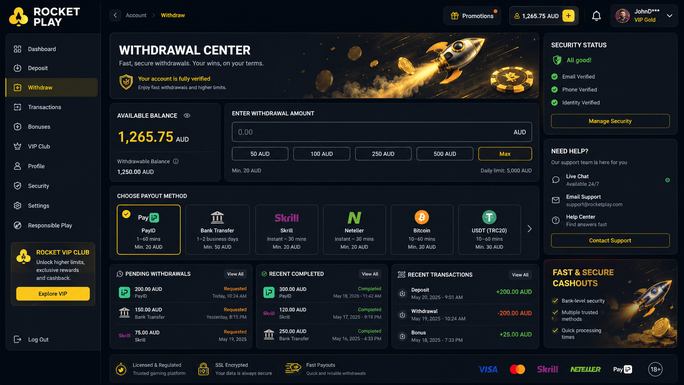
Verification is easy to dislike and still necessary. In practical terms, it sits alongside payment ownership checks and legal-age access as part of normal account use. A player may see it as friction, but a prepared account usually moves more smoothly than one that needs clarification at the last moment.
Imagine someone who wins after a few short sessions and wants everything finished immediately. The fastest way forward is rarely panic. It is usually one clean response with readable documents and matching details. Five rushed uploads often create more back-and-forth than one good submission.
Limits matter too. Deposit limits, session reminders, timeout tools, and self-exclusion controls are not decoration. They help players step back when the mood changes or when waiting for a pending transfer starts affecting decisions. People who use these tools tend to make calmer choices and are less likely to reverse a transfer or chase losses.
When A Timeout Makes Sense
Sometimes the smartest action is to pause. Imagine checking the wallet every few minutes, feeling irritated, and opening new games just to fill the wait. A short timeout can stop that pattern before impatience turns into a bad decision.
How Self-Exclusion Changes Access
Self-exclusion is a stronger option for players who want a real barrier, not a reminder. It affects account access in a serious way and should be treated as a practical safety step when control no longer feels reliable.
Avoiding Panic During Manual Review
Manual review does not automatically mean failure. Often it just means the request needs a person to check timing, amount, or recent account activity. Usually, calm answers and one clear message work better than repeated emotional follow-ups.
Mobile Use, Support, And Record Keeping
Mobile play changes behavior. On a phone, players move faster, read less, and tap through screens without noticing details that later matter. That is why many avoidable issues start on mobile, not because the process is bad, but because attention is lower.
Imagine you submit a request while commuting and forget to save the confirmation screen. Later, support asks about the time or amount, and now you are guessing. A simple screenshot would have solved the problem in seconds.
Support conversations improve when the player writes briefly and clearly. State the issue, mention the approximate request time, name the payment route, and say whether documents were already sent. Long emotional messages rarely help. Clear messages often do.
What To Save After Each Payment Step
A useful routine is to keep the confirmation screen, amount, and date each time you move money. That small record gives you a timeline if any question appears later.
How To Contact Support Efficiently
Think of support as reading a queue, not a private chat. Imagine fifty cases arriving one after another. The cleaner your message, the faster they can place it. Usually, a short timeline beats a long complaint.
Common Mistakes That Delay A Cashout
The most common mistakes are not dramatic. They are small and repetitive: inconsistent details, rushed changes, missing records, and unrealistic timing expectations. One issue may not matter. Several together can slow the whole process.
Players often create trouble by changing too much at once. They update email, phone number, security settings, and payment route right before requesting funds. Then they expect the system to treat the account as perfectly stable. Usually, it will not.
Another problem is confusing a submitted request with completed delivery. There is the request, the review, and then the receiving channel. When players separate those steps mentally, they panic less and make better choices.
Imagine a player who keeps canceling and resubmitting because they think it will force speed. In reality, constant changes can create more attention, not less. Stable actions usually outperform reactive ones.
Mixing Methods Too Often
Switching between several payment routes may feel harmless, especially when the wallet offers options. But review is easier when the pattern is simple. Usually, one familiar method works better than constant experimentation.
Ignoring Small Profile Errors
Tiny profile mistakes can sit quietly for weeks and then become important at the worst time. A typo in a surname or an old phone number is easy to ignore until a transfer depends on accurate matching. Fixing those details early is one of the easiest wins a player can get.
A Smarter 2026 Approach For Rocket Play In Australia
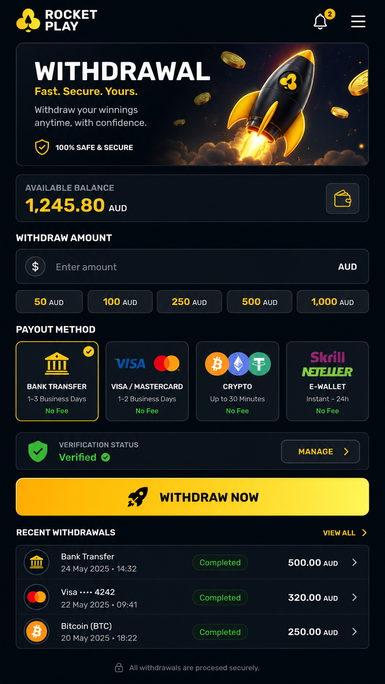
The strongest approach in 2026 is not based on luck. It is based on sequence. Set up the account properly, confirm details early, choose a stable payment route, and keep records. Players who do that usually experience less friction because they remove the avoidable problems before they appear.
Imagine opening the wallet after a good session and finding everything already aligned - profile complete, method familiar, records saved, and no last-minute edits to explain. That is what a smooth experience often looks like in practice.
There is also a broader point. A gaming platform should be used with patience, control, and realistic expectations. Legal-age users in Australia who plan ahead, respect their own limits, and answer clearly during review tend to feel more in control of the whole process.